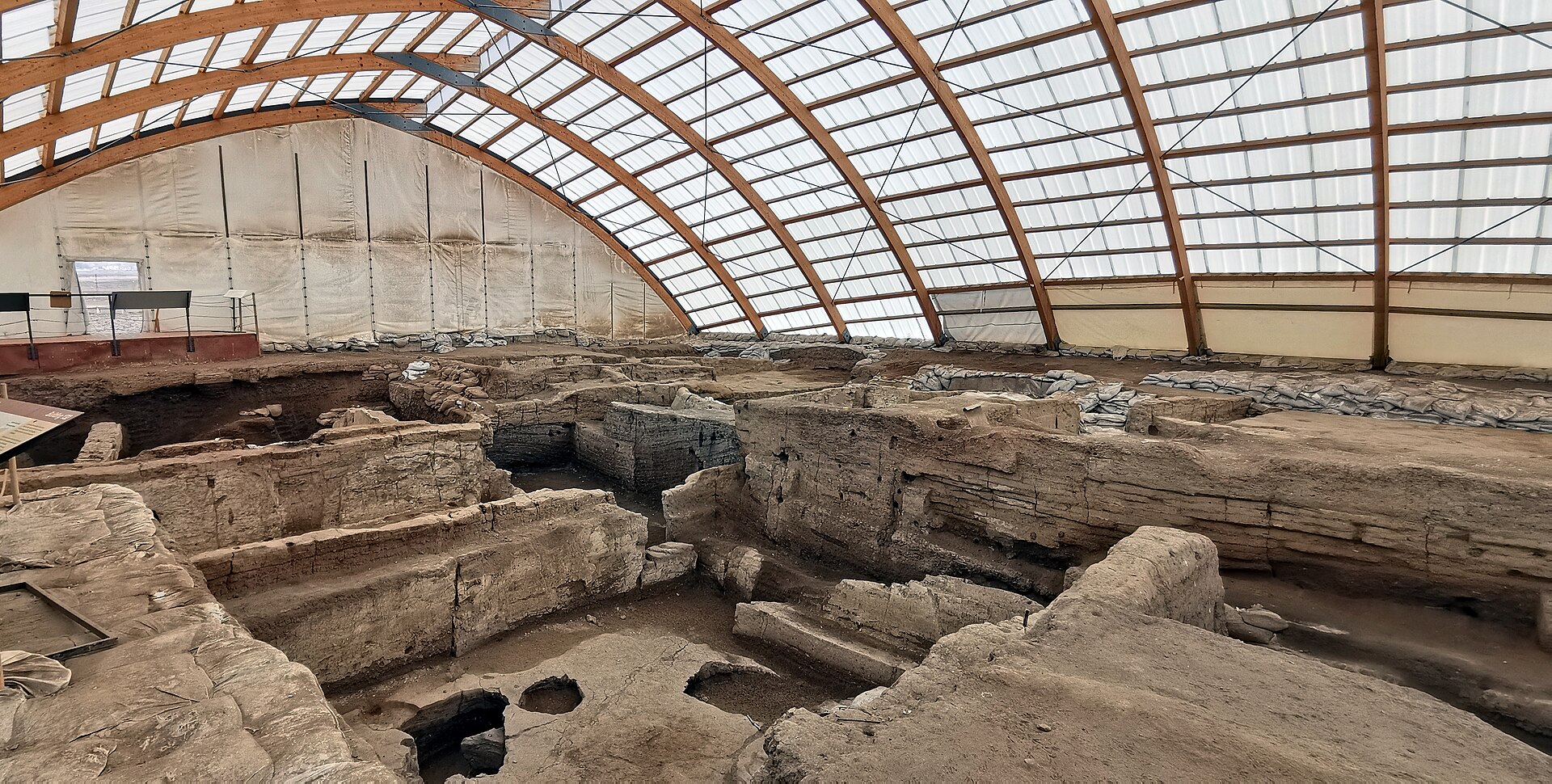
Researchers link Çatalhöyük burials to maternal households
A new report on Çatalhöyük, the Neolithic settlement in central Türkiye, says ancient DNA from human remains points to households organised around maternal lines, with girls receiving richer grave goods than boys. That is a narrower and more defensible reading than the viral shorthand of a “female-led society”: genetics can show kinship patterns and burial treatment, but it cannot by itself prove political rule. UNESCO describes Çatalhöyük as a rare, long-lived settlement that documents the move from villages to early urban agglomeration, while the Çatalhöyük Research Project says decades of excavation data remain central to interpreting its houses, burials and artefacts. For Belgian readers, the story matters less as a direct policy event than as a reminder that ancient DNA is reshaping museum narratives, university teaching and public debates about gender, family and early farming societies.
This is mainly a science-and-culture story for Belgian museum-goers, students, teachers, archaeologists and readers following heritage debates. Belgium’s universities and museums increasingly explain prehistory through genetics, migration and social organisation, so a high-profile Çatalhöyük claim will shape how early farming and gender are discussed in classrooms and exhibitions. The practical caution is important: ancient DNA can strengthen interpretations of kinship, but Belgian readers should distinguish matrilineal or matrilocal households from proven political rule by women.
Çatalhöyük (Neolithic settlement on the Konya Plain in central Türkiye, occupied for roughly two millennia) is one of the best-known early farming sites. The Konya Plain (central Anatolian plateau around the city of Konya) is the landscape in which the settlement developed. Anatolia (the Asian part of modern Türkiye) was a major corridor in the spread of farming into Europe. UNESCO (the UN cultural agency that maintains the World Heritage List) inscribed the Neolithic Site of Çatalhöyük in 2012. The Çatalhöyük Research Project (international excavation and archive project directed by Ian Hodder until 2018) preserves much of the modern field record. Ian Hodder (British archaeologist and former Stanford professor) led the long second phase of excavation. Ali Ozan (Pamukkale University archaeologist) is named by the project website as director of continuing excavations. Camilla Mazzucato, Michele Coscia and Mehmet Somel (researchers on a 2024 archaeogenomics paper) studied how biological ties and material culture can be read together at Çatalhöyük.
Background
UNESCO says the eastern mound at Çatalhöyük contains Neolithic occupation levels dated between 7400 and 6200 BC, while the western mound reflects Chalcolithic occupation from 6200 to 5200 BC. James Mellaart’s 1960s excavations popularised interpretations of female figurines and goddess symbolism, but later work under Ian Hodder treated simple matriarchy claims more cautiously. A 2024 paper by Mazzucato, Coscia and colleagues argued that archaeogenomic data need to be interpreted alongside houses and material culture, because biological relatedness alone does not equal social identity.
Why now
The story is timely because the lead report published on 12 June 2026 presented the DNA interpretation as a new finding, prompting renewed attention to Çatalhöyük’s long-running gender debate.
What to watch
Watch for the underlying peer-reviewed paper, the authors’ own wording on matrilineal, matrilocal or female-led organisation, and any response from the Çatalhöyük excavation community or UNESCO-linked heritage specialists.
Opposing perspectives
- Cautious archaeologists and archaeogenomics researchers
The 2024 Mazzucato, Coscia and colleagues paper argues that biological relatedness must be interpreted with house use, artefacts and burial practice. In this frame, the reported DNA result can support maternal-line or matrilocal households, but the phrase “female-led society” risks converting kinship evidence into a political claim the data may not prove.
- Public-history and gender-history readers
The lead report’s frame treats the burial and DNA pattern as evidence that women may have held central social status at Çatalhöyük. This view stresses that early farming communities were not automatically patriarchal and that richer female-child burials, if confirmed in the primary study, deserve serious interpretive weight.
Sources & evidence
- Al Jazeera - Archaeologists find ancient female-led society in Turkiye · 2026-06-12
- Times of India - Female-centred society discovered in 9,000-year-old Turkey settlement · 2026-06-11
- UNESCO World Heritage Centre - Neolithic Site of Çatalhöyük
- Çatalhöyük Research Project - Current excavations and archive information · 2021-11-16
- Camilla Mazzucato, Michele Coscia, Ayça Küçükakdağ Doğu, Scott Haddow, Muhammed Sıddık Kılıç, Eren Yüncü and Mehmet Some · 2024-06-27
- Live Science - Women likely ruled in Stone Age China, DNA analysis of 4,500-year-old skeletons reveals · 2025-06-21