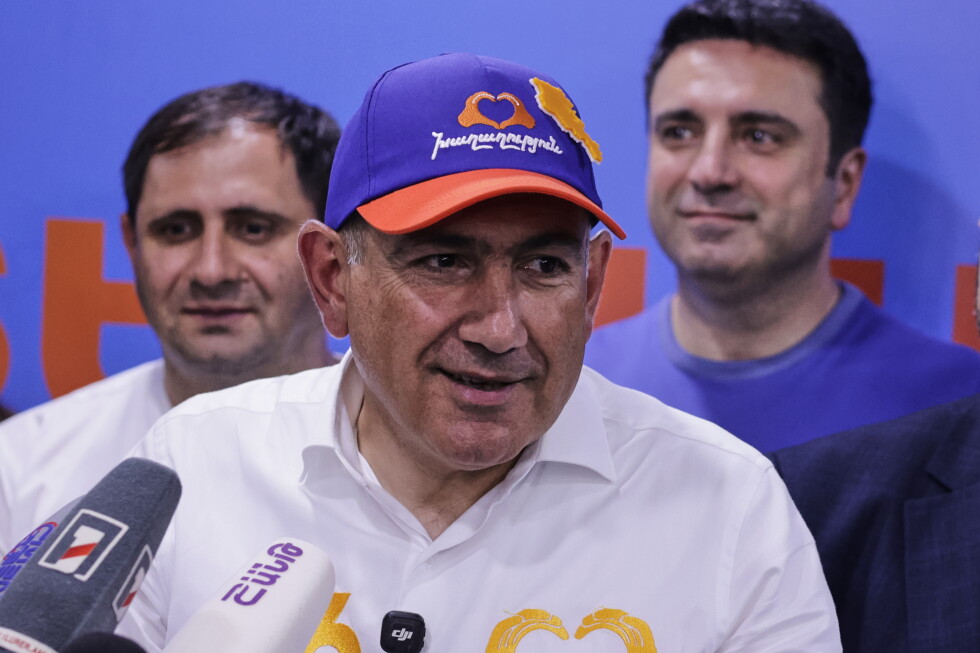
Strong Armenia challenges Pashinyan election win in Armenia
Strong Armenia, the pro-Russian opposition alliance linked to businessman Samvel Karapetyan, is challenging Armenia's parliamentary election result after Prime Minister Nikol Pashinyan's Civil Contract party claimed a renewed mandate. Armenia's Central Electoral Commission says the vote was held on June 7, 2026, and international reporting based on preliminary results put Civil Contract ahead with about half the vote, followed by Strong Armenia with just under a quarter. Strong Armenia says the result should be annulled, alleging manipulation; international observers cited in the reporting described the election as competitive and broadly transparent while noting pressure and polarisation around the campaign. The dispute matters beyond Yerevan because the election was a test of Armenia's westward turn after the 2023 loss of Nagorno-Karabakh. For the EU, including Belgium-based institutions and diplomats, the challenge complicates a partner country's attempt to move closer to Brussels while reducing dependence on Moscow.
For Belgian readers, the immediate stake is not local services but Europe's neighbourhood policy. EU institutions in Brussels are trying to stabilise the South Caucasus through diplomacy, civilian monitoring and economic support, and Armenia's contested election result affects that policy track. Belgian diplomats, EU staff, development contractors, energy-security analysts and businesses watching east-west connectivity all have an interest in whether Yerevan's westward course survives a legitimacy challenge. The story also matters to voters following how Russia contests influence near the EU's borders.
Nikol Pashinyan (Armenia's prime minister since the 2018 Velvet Revolution) leads Civil Contract, the governing party that presents itself as reformist and pro-European. Strong Armenia (opposition alliance founded in 2025) is associated with Samvel Karapetyan, a Russian-Armenian billionaire businessman whose side says he has been politically targeted. Armenia (South Caucasus republic between Turkey, Georgia, Iran and Azerbaijan) has historically relied on Russia for security but has moved closer to the EU since 2023. Nagorno-Karabakh (ethnic-Armenian enclave internationally recognised as part of Azerbaijan) was retaken by Azerbaijan in 2023, triggering the flight of more than 100,000 Armenians according to international reporting. The Central Electoral Commission of Armenia administers national elections. The European Union is relevant because EU institutions say Armenia-EU cooperation has deepened through the Comprehensive and Enhanced Partnership Agreement and later partnership agendas.
Background
Armenia's political direction has shifted sharply since the 2018 Velvet Revolution brought Pashinyan to power. After Azerbaijan's 2023 takeover of Nagorno-Karabakh, Armenia's government said Russian security guarantees had failed, froze participation in the Russian-led CSTO and sought deeper ties with the EU and United States. The European Parliament's 2024 resolution said Armenia could apply for EU membership if it met treaty criteria, while the EU later expanded support and border-monitoring engagement. Previous Armenian elections also drew disputes, but this challenge comes during a broader geopolitical reorientation from Moscow toward Brussels and Washington.
The wider picture
Armenia is trying to rebalance after losing confidence in Russian security guarantees, while Moscow wants to retain influence in a region linking the Black Sea, Caspian Sea, Turkey and Iran. Pashinyan's win strengthens the westward camp, but Strong Armenia's challenge shows that Russia-aligned politics remain organised and capable of contesting legitimacy inside Armenia.
Why now
The trigger is Strong Armenia's post-election move on June 12, 2026, following preliminary results from the June 7 parliamentary vote that put Pashinyan's Civil Contract party clearly ahead.
What to watch
Watch for the Central Electoral Commission's final certification, any court filings by Strong Armenia, observer mission follow-up statements and whether opposition rallies grow or fade. Also watch whether Pashinyan moves quickly on peace and EU-related legislation.
Opposing perspectives
- Strong Armenia opposition alliance
Strong Armenia says the election result should not stand because the campaign and count were distorted by pressure on opposition figures and alleged manipulation. In this frame, annulment is presented as a defence of electoral legitimacy, not merely a refusal to accept defeat.
- Civil Contract government camp
Pashinyan's camp presents the result as a renewed mandate for peace talks, institutional reform and closer EU ties. Its strongest argument is that voters had a clear geopolitical choice and rejected a return to parties associated with Moscow and Armenia's pre-2018 elite.
- EU institutions and Western diplomatic community
EU-facing institutions are likely to prioritise stability, election procedures and Armenia's reform trajectory. Their frame is that complaints should be handled through legal channels while the broader Armenia-EU partnership continues, because instability would weaken South Caucasus peace efforts.
- Russia-aligned regional constituency
The pro-Russian reading is that Armenia's westward turn risks economic and security exposure in a region where Russia still has leverage. This camp argues that closer alignment with Brussels and Washington may provoke Moscow without guaranteeing Armenia protection against Azerbaijan or Turkey.
Sources & evidence
- Al Jazeera - Pro-Russian opposition party calls for Armenian election result annulment · 2026-06-12
- Associated Press - Armenian Prime Minister Pashinyan claims victory in election seen as test of Russia's influence · 2026-06-08
- Associated Press - Armenians vote in general election under Russian pressure aimed at preventing a drift toward West · 2026-06-07
- The Guardian - Pro-western but populist: how Nikol Pashinyan retained power in Armenia · 2026-06-08
- Le Monde - Armenia elections: Nikol Pashinyan's victory confirms the country's shift toward Europe · 2026-06-08
- Central Electoral Commission of Armenia - National Assembly Elections 2026 · 2026-06-07
- European Parliament - Resolution of 13 March 2024 on closer ties between the EU and Armenia and the need for a peace agr · 2024-03-13
- International Republican Institute - Public Opinion Survey: Residents of Armenia, June 2025 · 2025-07-22