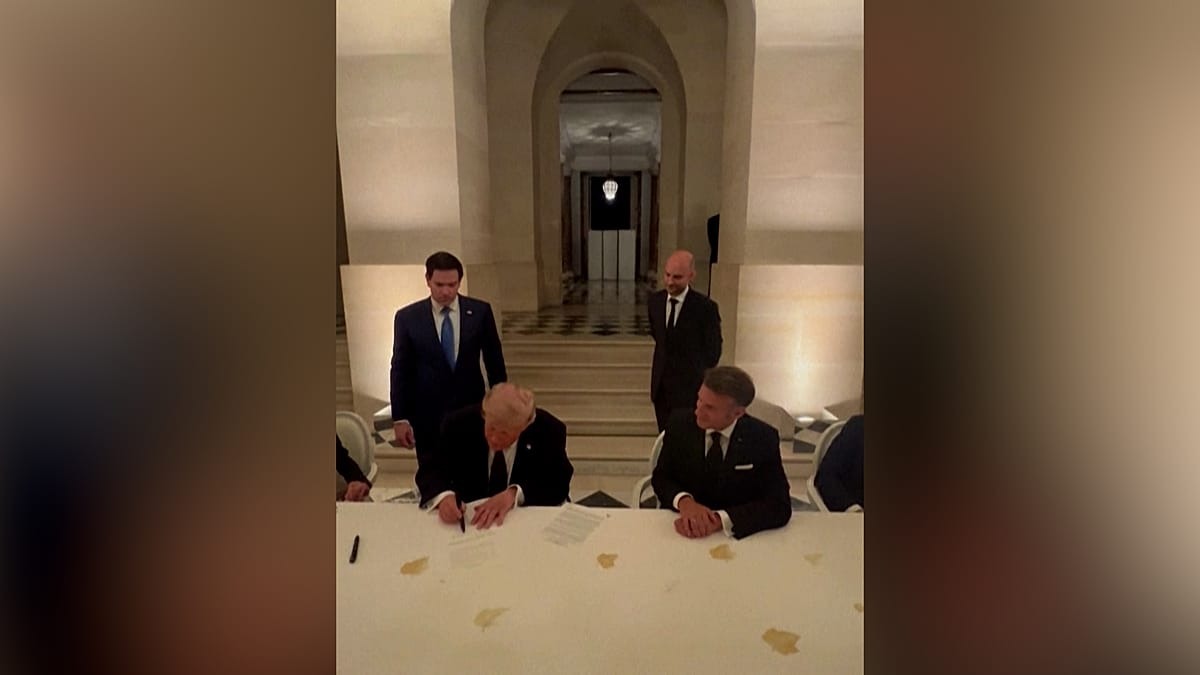
United States and Iran sign Versailles memorandum to reopen Hormuz
The United States and Iran have signed a preliminary memorandum intended to end a 110-day conflict and restore commercial traffic through the Strait of Hormuz, according to U.S. officials and statements by President Donald Trump, French President Emmanuel Macron and Pakistani Prime Minister Shehbaz Sharif. The document gives Washington and Tehran 60 days to negotiate a final settlement, links wider sanctions relief to nuclear talks, and requires Iran to restore safe passage through the Strait of Hormuz, with a 60-day toll-free period. U.S. officials say the text also covers Lebanon and Iran’s regional allies, although Israel is not a party to the memorandum. The immediate consequence is energy-market relief, but the agreement is politically fragile: Iran says it may charge shipping fees later, European leaders want follow-up talks on missiles and regional activity, and critics argue the deal front-loads economic gains for Tehran.
For Belgian residents, commuters, SMEs, hauliers, farmers and energy-intensive firms, the direct channel is prices: the deal could ease fuel, gas and fertiliser pressure if shipping resumes. For EU officials and Belgium’s federal energy and foreign-policy teams, the test is whether a U.S.-Iran bargain stabilises a chokepoint that affects European inflation and security without sidelining EU leverage on Iran’s nuclear programme, ballistic missiles and regional armed groups.
The Strait of Hormuz (the narrow Gulf waterway between Iran and Oman) is one of the world’s most important energy chokepoints. Donald Trump (U.S. president, returned to office in 2025) signed the memorandum for Washington. Masoud Pezeshkian (Iranian president since 2024) represents Tehran’s civilian government, while Mohammad Bagher Ghalibaf (speaker of Iran’s parliament and chief negotiator in the current talks) has shaped Iran’s public position. Emmanuel Macron (French president since 2017) hosted the Versailles signing moment during G7 diplomacy. Shehbaz Sharif (Pakistan’s prime minister) has presented Pakistan as a mediator. The International Atomic Energy Agency, or IAEA (the UN nuclear watchdog based in Vienna), would supervise any uranium dilution. Hezbollah (Iran-backed Lebanese armed movement and political party) is central because the memorandum’s ceasefire language refers to Lebanon. The G7 (Canada, France, Germany, Italy, Japan, the UK, the U.S. and the EU) has backed implementation while seeking broader constraints on Iran.
Background
The EIA’s 2012 analysis described Hormuz as the world’s most important oil transit chokepoint and said 2011 flows were almost 17 million barrels per day, about 35% of seaborne traded oil. The waterway has repeatedly been a flashpoint: U.S. forces escorted tankers during the 1987-1988 Tanker War, U.S. naval forces shot down Iran Air 655 over the Gulf in 1988, and Iran has periodically threatened closure during nuclear and sanctions crises. The 2015 JCPOA nuclear agreement offered sanctions relief for nuclear limits, but the United States withdrew in 2018, weakening the framework that European governments had tried to preserve.
The wider picture
The memorandum tests whether energy security can force a diplomatic reset after military escalation. It also shows a shift from multilateral Iran diplomacy toward a narrower U.S.-Iran transaction, with Europe seeking influence from the outside. China, Gulf states, Israel and Lebanon all sit in the background because Hormuz, oil exports and Hezbollah are linked in the deal’s consequences.
Why now
The immediate trigger is the signing and public circulation of the memorandum during G7 diplomacy, after months of conflict and pressure to reopen Hormuz. Markets and governments now need to know whether the document is an enforceable pause or only the start of another bargaining round.
What to watch
Watch the Switzerland meeting, any publication of the memorandum text, shipping volumes through Hormuz, U.S. Treasury waiver details, IAEA access arrangements, Iran’s position on post-60-day fees, and Israeli or Hezbollah actions that could test the Lebanon clause.
Opposing perspectives
- Trump administration / U.S. officials
U.S. officials frame the memorandum as a practical off-ramp: reopen Hormuz, stop the shooting, and use the 60-day window to turn a battlefield stalemate into nuclear negotiations. In that reading, immediate oil waivers are not a surrender of leverage but the price of preventing a wider economic shock.
- Iranian negotiators / Tehran
Mohammad Bagher Ghalibaf’s public line presents the document as proof that U.S. pressure failed. Tehran’s strongest argument is that Iran kept enrichment and sovereignty questions on the table, avoided shipping its uranium abroad at this stage, and forced Washington to discuss sanctions relief and Hormuz access rather than dictating surrender terms.
- European G7 governments
European G7 governments welcome the reopening of Hormuz because it relieves energy and inflation pressure, but their strongest concern is that the memorandum leaves missiles and regional armed groups unresolved. Their frame is implementation first, then a broader follow-on agreement covering Iran’s nuclear, ballistic and regional activity.
- Israel and U.S. hardliners
Israeli leaders and U.S. hardliners see the bargain as too permissive because Iran receives early economic benefits while retaining bargaining room on enrichment, missiles and regional allies. Their strongest argument is that the deal may stabilise markets while weakening deterrence if verification and enforcement are not clarified quickly.
Sources & evidence
- Euronews France, “Vidéo : la signature de l'accord américano-iranien à Versailles” · 2026-06-18
- Axios, “U.S. and Iran sign deal ahead of schedule” · 2026-06-17
- The Guardian, “US-Iran deal takeaways: reopening the strait of Hormuz, waived oil sanctions and Lebanon” · 2026-06-17
- The Guardian, “Trump signs Iran peace plan, claiming deal averts ‘worldwide depression’” · 2026-06-17
- U.S. Energy Information Administration, “The Strait of Hormuz is the world's most important oil transit chokepoint” · 2012-01-04
- Caitlin Talmadge, “Closing Time: Assessing the Iranian Threat to the Strait of Hormuz”, International Security, 2008 · 2008-07-01
- The Guardian, “Donald Trump's Iran deal met with anger, relief and incredulity” · 2026-06-18