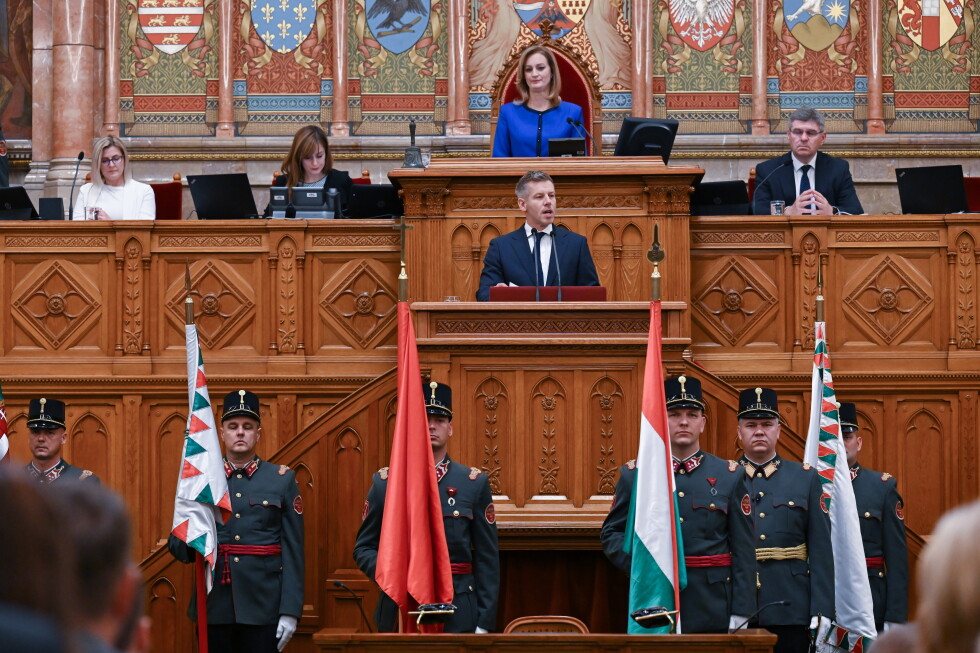
Viktor Orbán keeps Fidesz leadership after Hungary defeat
Fidesz has kept Viktor Orbán as party leader after Hungary's April election defeat, leaving the former prime minister as the central figure of the country's right-wing opposition rather than closing the Orbán era inside the party itself. Fidesz's party congress re-elected him on 13 June after he ran unopposed, while Orbán accepted responsibility for the loss and argued that the party must learn to operate as an opposition force. The decision matters beyond Budapest because Péter Magyar's new Tisza government has already shifted Hungary back toward EU cooperation, including rule-of-law reforms, frozen EU funds and Ukraine policy. Orbán's continued command of Fidesz means the old governing network remains politically organised, even after losing state power. For Brussels, the issue is whether Hungary's EU reset becomes institutional change or a contested interlude before the next electoral cycle.
Belgian voters, diplomats, businesses and EU-facing organisations should care because Hungary has been one of the EU's main rule-of-law and Ukraine-policy battlegrounds. Brussels-based EU institutions negotiate the funds, sanctions and enlargement files affected by Budapest's new course, while Belgian federal officials participate in Council decisions that often require unity. Orbán's survival as Fidesz leader keeps a powerful Eurosceptic actor in the system, even as Magyar's government tries to repair relations with the EU.
Viktor Orbán (Hungarian politician, born in 1963, prime minister in 1998-2002 and 2010-2026) built Fidesz into Hungary's dominant party before losing power in April 2026. Fidesz (Hungarian Civic Alliance, founded in 1988 as a liberal youth movement) is now Hungary's main opposition party after governing with KDNP for 16 years. Péter Magyar (Hungarian lawyer and former Fidesz insider, born in 1981) leads the centre-right Tisza Party and became prime minister in May 2026. Tisza Party (Respect and Freedom Party, founded in 2020) defeated Fidesz on a pro-European, anti-corruption platform. MTI (Hungary's state news agency, founded in 1881) was cited for the Fidesz delegate tally. The European Public Prosecutor's Office (EU anti-fraud prosecutor based in Luxembourg, operational since 2021) is relevant because Magyar's government has applied to join it after Orbán had refused.
Background
Orbán has survived defeat before. After his first premiership ended in 2002, he kept control of Fidesz and returned to power in 2010. Fidesz then used repeated parliamentary supermajorities to pass Hungary's 2011 Fundamental Law and reshape courts, media regulation, universities and watchdog bodies. The European Parliament triggered Article 7 scrutiny of Hungary in 2018, and the EU later used budget conditionality to freeze funds over rule-of-law concerns. The April 2026 election was different because Tisza won a two-thirds majority, giving Magyar the legal capacity to undo parts of the Orbán-era system.
The wider picture
Orbán built influence by positioning Hungary as a dissenting EU and NATO member with warmer ties to Moscow and parts of the global right. His election loss weakened that model, especially as Russia's war against Ukraine keeps enlargement, sanctions and security policy at the top of the European agenda. Keeping Fidesz leadership lets him preserve a platform in those broader ideological and geopolitical fights.
Why now
Fidesz held its leadership vote two months after losing the 12 April parliamentary election and one month after Magyar took office. The congress was the first major test of whether Orbán would be pushed aside or remain the party's organising figure.
What to watch
Watch whether Fidesz changes its parliamentary strategy under Gergely Gulyás, how Orbán rebuilds party structures outside parliament, and whether Magyar's constitutional and anti-corruption reforms face resistance from Orbán-era appointees. EU fund releases and Ukraine accession steps will show whether Budapest's reset holds.
Opposing perspectives
- Fidesz loyalists
The Al Jazeera / Reuters item frames Orbán's argument as continuity with adaptation: Fidesz lost government, but its core political community should not disband around a defeat. In this view, Orbán remains the only figure with the authority to turn a governing machine into an opposition party capable of returning to office.
- Tisza government / Magyar reform camp
AP's coverage of Magyar's first weeks in office frames the change of government as a mandate to dismantle Orbán-era institutions, restore rule-of-law safeguards and join EU anti-fraud structures. From that perspective, Orbán's re-election keeps the old power centre intact and makes reform a political contest, not just an administrative programme.
- EU institutions
The AP report on the EU funds decision presents Brussels as rewarding rapid reforms and renewed cooperation by Magyar's government. EU institutions can treat Orbán's continued party leadership as a reminder that Hungary's pro-EU turn is not yet irreversible, especially on Ukraine, funds conditionality and future unanimity files.
Sources & evidence
- Al Jazeera / Reuters - Hungary's former PM Orban re-elected party leader despite election loss · 2026-06-13
- AP - Hungary's Péter Magyar sworn in as prime minister, ending Viktor Orbán's 16-year rule · 2026-05-09
- AP - Hungarian government's new Cabinet sworn into office under Péter Magyar · 2026-05-12
- AP - European Union unlocks billions in funding for Hungary after rapid reforms by new leader Magyar · 2026-05-29
- The Guardian - Hungarian opposition ousts Viktor Orbán after 16 years in power · 2026-04-13
- Freedom House - Hungary: Nations in Transit 2024 Country Report, Zsuzsanna Végh, 2024 · 2024-01-01
- European Parliament - Resolution on the existence of a clear risk of a serious breach by Hungary of EU values · 2022-09-15
- EUR-Lex - Regulation (EU, Euratom) 2020/2092 on a general regime of conditionality for the protection of the Union budge · 2020-12-16