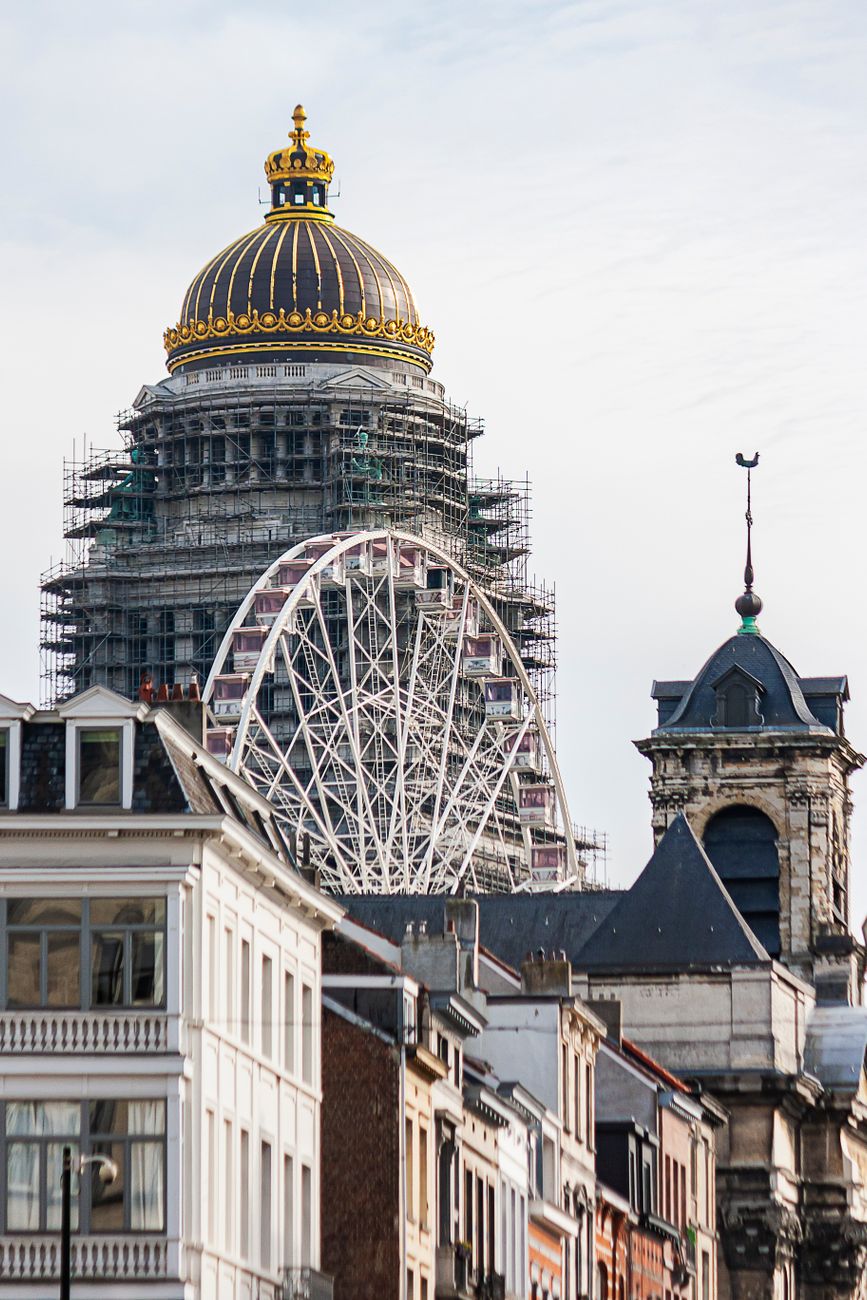
Why does Brussels’ Palace of Justice facade finally emerging from scaffolding matter?
A visible part of Brussels’ Palace of Justice has been liberee ses echafaudages: the central section of the front facade on Place Poelaert has been restored and freed from the metal frame that helped define the city skyline for four decades. For people living in Bruxelles, working in Belgian justice, or moving through the city’s EU and diplomatic circuits, this is more than a cosmetic reveal. It is an early test of whether Belgium can restore a federal justice symbol without repeating the delays, cost rises and institutional drift that made the building a national embarrassment. The Federal Buildings Agency says the first phase covers the front facade, the peristyle and the esplanade facing Place Poelaert. BX1 reported that the right side was completed in May 2025, the central part has now been unveiled, and the remaining left side should follow during summer 2026. A lift platform for people with reduced mobility, restored bronze doors, repaired stairs, woodwork and statues are part of the works still tied to this first phase. The next question is not simply when tourists get a cleaner view. The Palace houses or is linked to core Belgian judicial institutions, including the Court of Cassation, the Brussels Court of Appeal and the Brussels legal community. It also stands in a city that hosts the European Commission, Council of the EU and NATO, making the state of Belgium’s own court infrastructure unusually visible to an international public. The centre of gravity remains Belgian: this is about justice, heritage and public estate management in Brussels, not Brussels-as-EU-capital alone.
For Belgium-based readers, the reveal is practical and institutional. First, it changes the everyday face of one of Brussels’ most visible landmarks, at Place Poelaert, a transport and viewing point used by residents, commuters, lawyers, court users and visitors. Second, it provides a measurable milestone in a restoration programme that has repeatedly tested public confidence: the facade is being cleaned, repaired and rebuilt with attention to original materials, but the full exterior programme is not expected to finish before 2035. Third, the building’s condition is tied to the credibility of Belgian justice itself. A courthouse that has needed scaffolding since the 1980s sends a different public message from one that is visibly maintained, accessible and safe.
The subject is the restoration of the facade palais of the Palace of Justice of Brussels, the vast 19th-century courthouse on Place Poelaert between the upper city and the Marolles. The immediate news is that a partie facade, specifically the central front section, has been facade liberee echafaudages after restoration work that began in 2023. The main stakeholders are the Federal Buildings Agency, Public Action and Modernisation Minister Vanessa Matz, the Belgian judiciary, Brussels lawyers, heritage advocates such as the Poelaert Foundation, residents of the Marolles and users of the courts. The building is owned and managed at federal level, but its urban and symbolic impact is strongly Brussels-based.
Background
The Palace of Justice was designed by Joseph Poelaert, built from 1866 and inaugurated in 1883 under Leopold II. Its scale made it one of the largest courthouse buildings of its era, but it also carried a heavy local memory: part of the Marolles was cleared for its construction, and later enlargement plans met fierce neighbourhood resistance, including the 1969 Marolles mobilisation. The building suffered major wartime damage in 1944, was partly restored after the war, and has been under major renovation pressure for decades. The scaffolding installed from the 1980s became so enduring that it became part of Brussels’ visual folklore.
Impact
Regional — In Brussels, the main impact is concentrated around Place Poelaert, the Marolles, Rue aux Laines, Rue de Wynants and Rue des Minimes. The works affect the visual identity of the upper-lower city edge, tourist flows, court access, mobility around the square and the daily working environment of judicial staff and lawyers.
Opposing perspectives
- Federal buildings and heritage view
Public Action and Modernisation Minister Vanessa Matz frames the reveal as a civic milestone: a 'whole generation of Belgians' has known the Palace mainly through scaffolding. This Belgian institutional framing is less about tourist spectacle than about restoring confidence in the state’s ability to maintain the infrastructure of justice.
- Cost-control and working-conditions view
Vlaams Belang MP Britt Huybrechts has argued that 'fundamental questions' are needed when a renovation lasts so long and costs keep rising. This perspective shifts the story away from architectural celebration and toward public-accountability questions: taxpayers, judicial staff and court users still need safe, functional interiors, not just a cleaner facade.
- Poelaert Foundation and preservation view
Dirk Van Gerven of the Poelaert Foundation has defended the building as a 'world-class architectural masterpiece'. That position accepts the inconvenience and cost of restoration as the price of preserving a rare judicial monument, while critics see the same building as proof that Belgium struggles to prioritise modern court needs.
Sources & evidence
- BX1 · 2026-06-10
- BX1 · 2026-06-08
- Federal Buildings Agency / Régie des Bâtiments
- RTBF · 2018-09-06
- The Times · 2026-03-11
- UNESCO World Heritage Centre